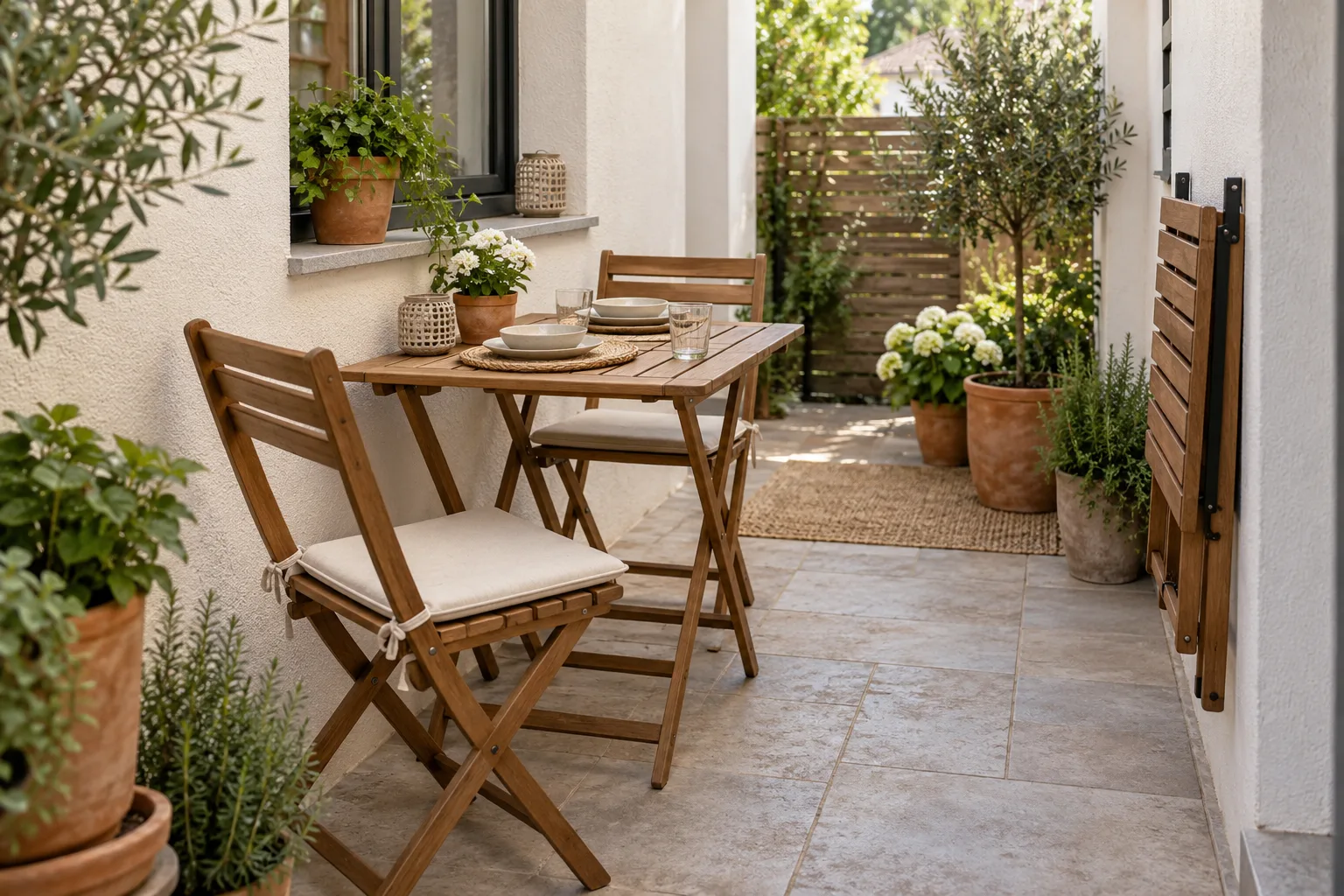
A folding patio table earns its space only when opening, using, closing, and storing it are all convenient. A small listed tabletop can still create a crowded patio if the legs block knees, chairs need extra room, or the folded table has nowhere dry and secure to go.
Compare both configurations before buying. Measure the table at its widest open point, then record the folded thickness, height, and shape. Add the chairs and users to the open plan, and add the carry route and storage location to the closed plan.
Decision factors for a folding patio table
- Open footprint: include hinges, braces, feet, and leaf supports.
- Occupied footprint: add chairs, knees, seated users, and the route behind them.
- Stored footprint: folded width, depth, height, and whether the table stands safely when stored.
- Setup: identify pinch points, locks, and the space needed to unfold it.
- Leg position: check knee room and chair placement at each usable side.
- Stability: follow setup, surface, loading, and locking instructions.
- Exposure: confirm outdoor-use and maintenance guidance for the specific table.
- Portability: consider weight, grip points, stairs, thresholds, and who will move it.
Folding patio table types compared
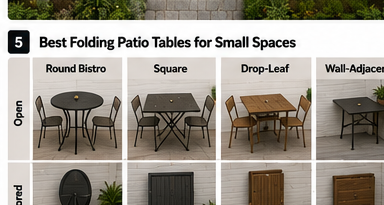
| Table type | Best suited for | Space advantage | Tradeoff to check |
|---|---|---|---|
| Round folding bistro table | Coffee or meals for one or two | No projecting corners | Limited usable surface and central legroom |
| Square folding table | Two-seat dining or flexible work | Fits rectilinear walls and corners | Corners can enter the route |
| Slatted roll-top table | Camping-style portability | Packs into a narrow bundle | Assembly steps and surface gaps |
| Drop-leaf table | One everyday seat with occasional expansion | Changes depth without full storage | Leaf support and leg placement |
| Wall-adjacent folding table | Approved wall-side use | Preserves floor when closed | Mounting permission and wall compatibility |
| Folding console table | Serving or plant work along an edge | Shallow linear footprint | Often not comfortable for seated dining |
Round bistro tables simplify circulation
A round folding table avoids sharp corners and can work well for two chairs. It is most efficient when the base allows both users to sit without straddling braces. Check the usable top after accounting for plates, drinks, and any umbrella pole.
A compact diameter does not guarantee compact use. Chairs and bodies may extend farther than the tabletop, so test the full occupied arrangement rather than placing a circle on an empty plan.
Square tables make wall and corner placement easier
A square table can align neatly with a straight wall and may offer more usable corners for two people. It also creates projecting corners when turned diagonally or placed near the main route. A folding model should lock into its intended open position without relying on a wall for stability unless the instructions require and permit it.
Drop-leaf tables support two modes
A drop-leaf table can remain shallow for daily coffee and expand when a second person joins. This works best when the legs and supports do not migrate into the seated knee space as the leaf changes. Check both configurations and the room required to operate the leaf.
If the table stays outdoors, confirm how hinges, hardware, and surfaces should be maintained. If it is stored indoors, make sure the folded shape fits through the door without scraping walls or requiring unsafe lifting.
Wall-adjacent folding tables need permission and compatibility
A fold-down wall table can free floor space when closed, but permanent attachment changes the decision. Do not mount to siding, masonry, railings, or structural elements without exact product compatibility, property approval, and appropriate installation. Renters should favor freestanding options unless written permission and a suitable system are in place.
This post may contain affiliate links. If you buy through them, Small Space Outdoors may earn a commission at no additional cost to you.
Current folding patio table examples to compare
These are current examples for three different storage and setup needs, not ranked picks. Small Space Outdoors has not personally tested them. Tape the open footprint, chair space, folding path, and storage route before ordering, and verify current locking, mounting, care, and property requirements.
For a compact round bistro surface: Tangkula 23-Inch Folding Table
Amazon lists this outdoor table at 23 inches in diameter and 26.5 inches high, with a tempered-glass top, metal frame, folding design, and an unfolded-state fixing device. Editorially, the round top removes projecting corners in a tight seating zone. The current listing does not provide a folded-depth measurement, so measure the intended storage location conservatively.
View the Tangkula 23-Inch Round Folding Patio Table on Amazon.
For a square table with a documented stored size: Flash Furniture Martindale Folding Patio Table
Amazon currently lists a solid acacia table measuring 23.5 inches square by 29.5 inches high. Its listed folded size is 23.5 by 2.5 by 37.5 inches, and the tabletop is slatted. This is useful when a square edge fits better beside a wall or corner and the narrow folded depth works along the planned storage route.
View the Flash Furniture Martindale Folding Patio Table on Amazon.
For an approved compatible railing: Tangkula Folding Hanging Table
Amazon lists a 24-by-19-inch iron tabletop with five height settings from 24 to 32.5 inches and states that the attachment fits a railing less than 4 inches wide. The tabletop folds down when not in use. This format frees floor space, but it is not a freestanding table: verify the exact railing, installation method, manufacturer instructions, and landlord, building, lease, or association permission before considering it.
View the Tangkula Folding Hanging Table on Amazon.
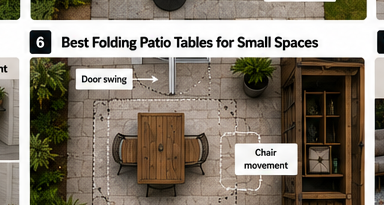
Test the occupied footprint
Set boxes or a temporary top at the planned table height and place chairs in their real positions. Sit down, stand up, and have another person pass behind if that reflects normal use. Open the exterior door and locate planters, grills, drains, and steps.
General circulation suggestions are planning guidance, not universal rules. Required routes and clearances vary by property, local requirements, door or exit conditions, and lease or association restrictions. Keep required exits unobstructed.
Plan where the folded table lives
A folding feature is useful only when the storage process is repeatable. Decide whether the table will stand in an outdoor storage bench, hang from an approved system, slide into a closet, or lean in a protected interior space. Follow storage instructions and do not assume a folded table is stable on edge.
Measure thresholds, turns, stair width, and the storage opening. A handle or manageable grip can matter more than a small difference in tabletop size.
Pair the table with the right chairs
Folding chairs can reduce the stored footprint of the whole dining set, but only if the chairs are comfortable enough to use and have their own storage location. Nesting or stackable chairs may be a better match when they remain outside and the table moves more often.
For complete three-piece arrangements, compare the decision framework in Best 3-Piece Patio Sets for Small Spaces. Balcony users can also review Best Balcony Furniture for Small Spaces for building and route considerations.
Buying checklist
- Measure open, occupied, folded, and storage footprints.
- Check legroom and brace positions from every intended seat.
- Confirm the locking and folding sequence from current instructions.
- Plan a safe carry route and stable storage location.
- Verify outdoor exposure and maintenance guidance.
- Keep doors, drains, steps, utilities, and required exits clear.
- Confirm mounting permission for any attached design.
The takeaway
For most compact patios, a freestanding round or square folding bistro table is the easiest starting point. A drop-leaf design can add flexibility, while an attached fold-down table makes sense only with exact compatibility and permission. Judge the table by its occupied and stored footprint—not just the dimensions of the top.