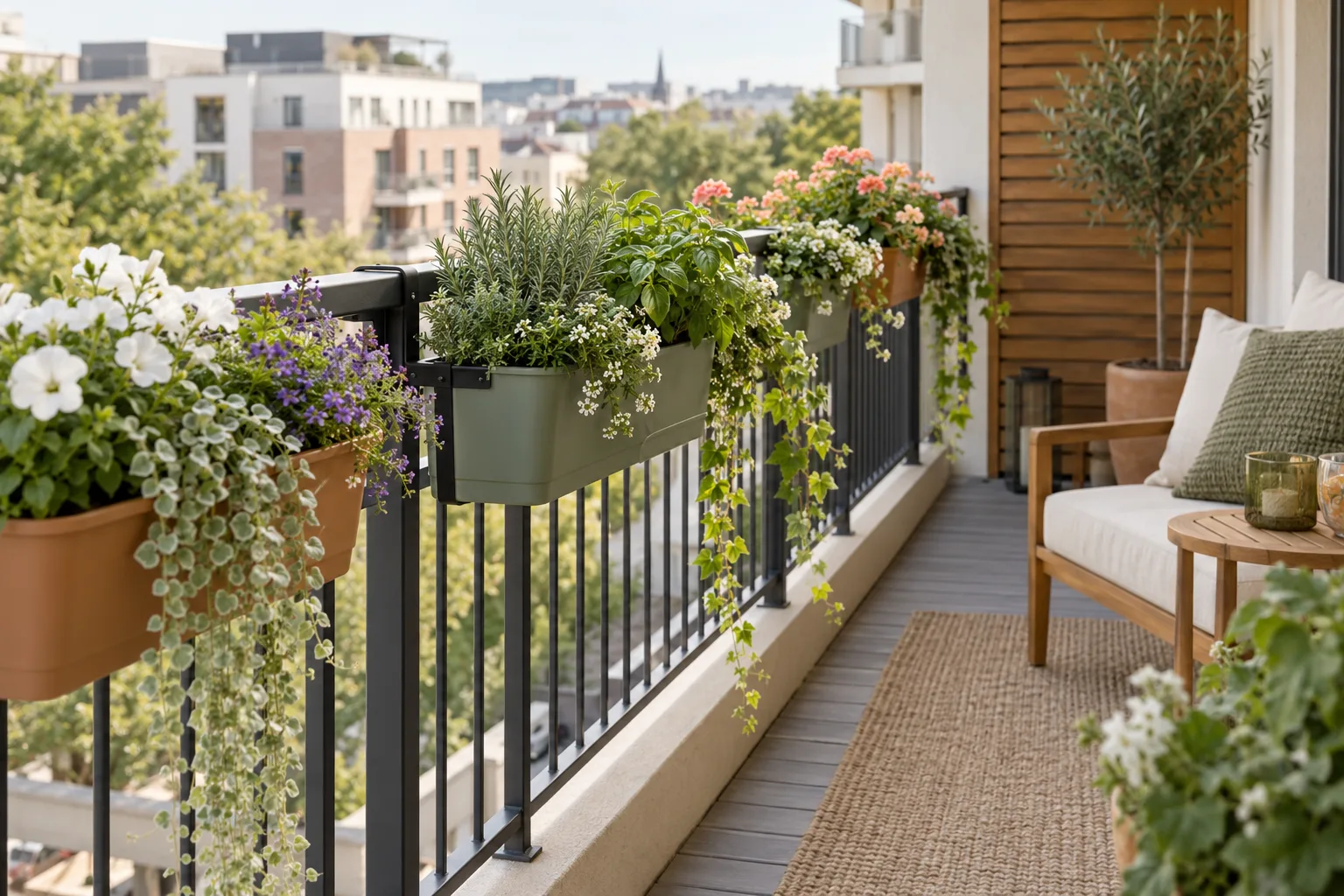
A railing planter can preserve balcony floor space, but it should never be chosen by planter width alone. The railing type, dimensions, material, condition, attachment system, loaded weight, wind exposure, drainage, area below, and property rules all determine whether a railing-mounted container is appropriate.
Do not assume a railing can accept attachments or added loads. Confirm permission and structural suitability with the appropriate property owner, building management, association, and qualified authority. Use only a planter and mounting system explicitly compatible with the exact railing and installed as the manufacturer directs.
Safety and permission come before planting capacity
- Identify the railing material, profile, top shape, dimensions, spacing, and condition.
- Confirm that attachments and added loads are permitted by the landlord, lease, building, HOA or association, and local requirements.
- Use a manufacturer-designed attachment system compatible with both planter and railing; do not improvise with wire, rope, generic hooks, or zip ties.
- Account for the planter, hardware, wet growing medium, water, mature plants, and seasonal wind exposure.
- Consider people, property, and access below the balcony.
- Keep required exits, railing function, inspection access, and drainage unobstructed.
- Follow current instructions for installation, load, wind, maintenance, and removal.
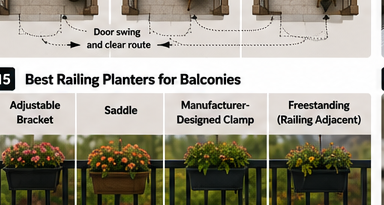
Railing-planter formats compared
| Format | Potential advantage | Compatibility issue | When to choose another option |
|---|---|---|---|
| Adjustable bracket box | May fit a defined range of rail profiles | Adjustment range and locking method must match exactly | If the railing shape or condition falls outside instructions |
| Over-rail saddle planter | Balances across a compatible rail | Rail width, planter fit, retention, and wind guidance | If movement or secure retention is uncertain |
| Manufacturer-specific clamp system | Purpose-designed connection | Only approved planter, clamp, and railing combinations apply | If parts are mixed or documentation is unclear |
| Inside-rail hanging planter | Keeps the container on the balcony side | Attachment and railing function still matter | If it obstructs the route or creates a climbing hazard |
| Freestanding railing-adjacent planter | Avoids railing attachment | Uses floor space and still has loaded-weight considerations | If the base cannot remain stable and clear |
Adjustable brackets are not universally compatible
An adjustable bracket may accommodate a documented range of rail widths or profiles, but the adjustment mechanism must close and lock as intended. Rounded, glass, cable, decorative, damaged, or unusually shaped railings may not be suitable.
Do not add shims, drill holes, or modify hardware unless the manufacturer explicitly directs it and the property permits it. If fit is uncertain, use a stable freestanding planter in an approved location.
Saddle planters need secure retention
A saddle planter straddles the top rail and may look self-centering. Its suitability still depends on exact rail width, planter design, retention system, load distribution, and wind instructions. Visual balance is not evidence of secure attachment.
Keep the planter on the permitted side of the railing and follow instructions for clips, fasteners, inserts, and drainage. Never place a container where it can fall or shed objects onto an area below.
Inside-rail placement may reduce consequences below
Some compatible systems keep the container entirely on the balcony side. This can simplify watering and plant access, but it does not remove the need for approval, load review, secure mounting, or clear circulation.
Avoid creating a foothold or climbing aid, especially where children may be present. Railing function and height requirements vary; confirm the site-specific rules.
This post may contain affiliate links. If you buy through them, Small Space Outdoors may earn a commission at no additional cost to you.
Current railing planter examples to compare
These are current examples for three different attachment approaches, not ranked picks. Small Space Outdoors has not personally tested them. Before ordering, verify the exact railing material, shape, dimensions, condition, permitted added load, drainage path, manufacturer instructions, and all landlord, building, lease, HOA or association, and property restrictions. Do not improvise a fit.
For a complete adjustable-bracket planter: Veradek Brixton Railing Planter
Amazon lists exterior dimensions of 36 inches long by 11 inches wide by 11 inches high, with a recycled-plastic planter and galvanized-steel adjustable attachment for railings 1 to 6 inches wide. The manufacturer specifies inward-facing installation only and says not to install it higher than 4 feet above the ground. Those product-specific limits do not establish that a particular railing or property permits the planter.
View the Veradek Brixton Railing Planter on Amazon.
For a saddle-style compression fit: Bloem Modica 12-Inch Deck Rail Planter
Amazon lists a 12-inch resin planter with a 2-gallon capacity, optional punch-out drainage holes, and compression-fit ranges of 3.25 to 3.75 inches or 5.25 to 5.75 inches. Editorially, this option is relevant only when the existing rail falls within one of the stated ranges and the property permits the loaded planter. Do not modify or improvise the attachment to make an incompatible railing work.
View the Bloem Modica Deck Rail Planter on Amazon.
For an existing compatible Mayne window box: Mayne Adjustable Deck Rail Bracket
This listing is for a two-pack of black powder-coated steel rail brackets, not a complete planter. Amazon says the brackets fit 2-by-4 or 2-by-6 wood railings and attach to compatible Mayne window-box hardware sold separately. This hardware-only format can avoid replacing an existing compatible box, but every component, fastener, railing, drainage route, and property permission must be verified as one system.
View the Mayne Adjustable Deck Rail Bracket on Amazon.
Plan the loaded planter and drainage
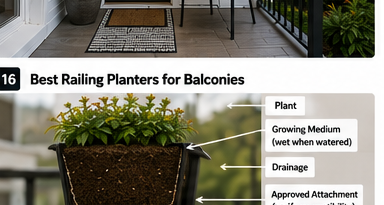
The empty container is only the starting load. Include mounting hardware, wet growing medium, retained water, mature root and plant mass, and any seasonal decorations. Use the manufacturer’s stated limits and the property’s approved conditions; do not estimate railing capacity.
Plan where water exits. Use only drainage trays, liners, reservoirs, and irrigation arrangements compatible with the planter. Prevent runoff onto neighbors, facades, entrances, electrical equipment, or walkways.
Choose plants for the railing microclimate
Railings can expose plants to stronger wind, reflected heat, faster drying, and uneven sun. Observe the site through the day and choose plants for the actual light, temperature, and regional conditions. Keep mature growth from entering the route or extending into neighboring space.
Place trailing plants only where they will not tangle in hardware, obscure inspection, or drop material below. Reach every planter without climbing or leaning over the railing.
Maintenance should not require risky access
Watering, pruning, cleaning, and seasonal removal should all happen from a stable position on the balcony floor. If maintenance requires reaching outside the railing or lifting an awkward loaded container, choose a different format.
Inspect attachments at the frequency the manufacturer specifies and after relevant weather events. Remove the planter if hardware, railing condition, or fit changes.
Connect the planter to the balcony layout
Railing planters should not compensate for an already crowded floor plan. Start with Best Balcony Furniture for Small Spaces, then decide whether the railing zone remains appropriate. Compare freestanding alternatives in Best Vertical Planters for Balconies and Small Patios and privacy choices in Best Privacy Screens for Balconies and Small Patios.
Decision checklist
- Identify and inspect the exact railing.
- Obtain required property and building approval.
- Match planter, attachment, and railing using current manufacturer documentation.
- Review the complete loaded condition and area below.
- Plan controlled drainage and safe maintenance access.
- Choose plants for mature size and exposure.
- Keep exits, railing function, and inspection access clear.
- Use a freestanding planter if compatibility is uncertain.
The takeaway
The best railing planter is not the box with the most capacity. It is a documented, approved system that matches the exact railing and can be watered and maintained safely. When permission, load suitability, or attachment compatibility is unclear, a stable freestanding planter is the better small-space choice.