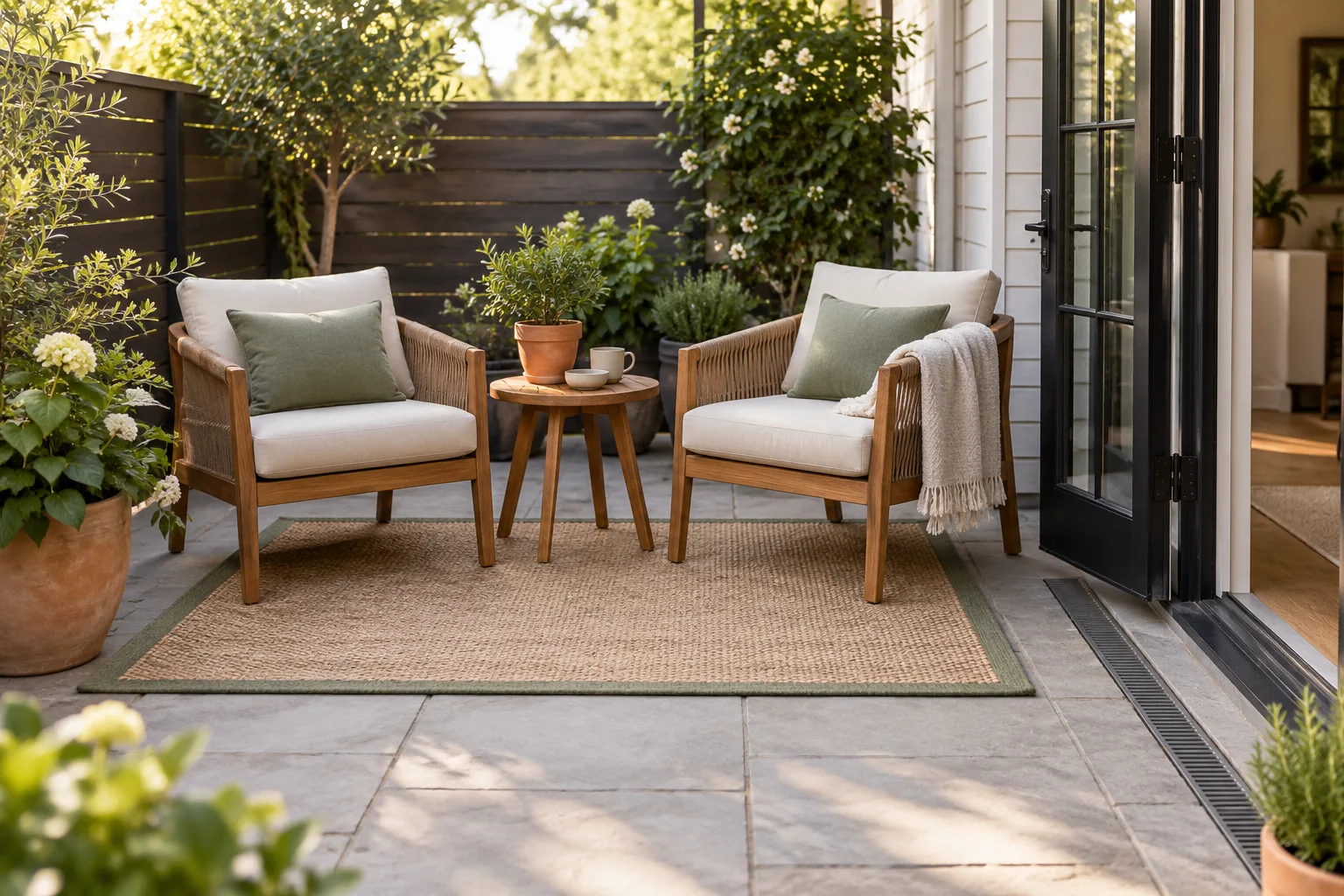
An outdoor rug can make a small patio feel more intentional, but it also adds an edge, a drying surface, and another item that must work around doors and drainage. The best choice is not automatically the largest rug that fits. It is the one that supports the furniture plan without creating a damp, curled, or awkward route.
Measure after placing the main furniture. Decide which legs should rest on the rug, where people step when they stand, and how the rug will be lifted for cleaning. Then compare construction and care instructions for the site’s actual exposure.
What matters most on a compact patio
- Finished size: use actual listed dimensions rather than the nominal size name.
- Furniture contact: decide whether all legs, front legs, or no legs will sit on the rug.
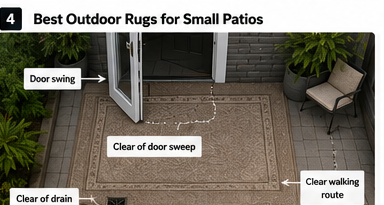
- Door clearance: confirm the door can open over the rug and any pad.
- Edge placement: keep corners out of the most-used walking line.
- Drainage and drying: protect drains and allow the surface beneath to dry.
- Surface compatibility: check care guidance for wood, composite, concrete, tile, or coated floors.
- Exposure: sun, rain, debris, pets, and food use change the maintenance burden.
- Storage: plan where the cleaned, dry rug will go during severe weather or off-season periods.
Outdoor rug formats compared
| Format | Useful for | Small-space advantage | Main planning question |
|---|---|---|---|
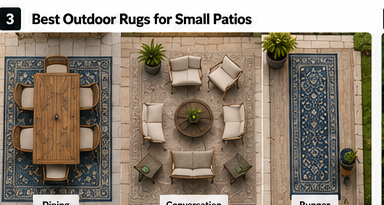
| Compact rectangular rug | Two chairs, a loveseat, or a bistro set | Defines one activity zone | Which furniture legs should stay on it? |
| Square rug | Square patios and centered dining groups | Echoes the room shape | Will corners enter the route? |
| Round rug | Round table or curved furniture group | Softens a boxy layout | Does the diameter support chair movement? |
| Runner | Narrow porch or side patio | Adds color without covering the full floor | Can doors and feet clear the edges? |
| Reversible woven rug | Layouts that benefit from two simple looks | May offer flexible styling | What do current care instructions allow? |
| Small mat plus bare floor | Very tight entries or wet zones | Minimal drying and storage burden | Is the mat stable and sized for the step area? |
Choose a rug size from furniture contact points
For a compact dining set, keep the relationship between chair movement and rug edges in mind. A rug that ends directly where chair feet travel can catch or bunch. If a suitably sized rug would overwhelm the patio, leaving the dining set on the bare surface may work better.
For a conversation layout, placing only the front legs of chairs or a loveseat on the rug can visually connect the group while preserving bare floor near the route. The legs should sit securely and consistently rather than balancing on a thick edge.
Flat-woven rugs keep the profile simple
A low-profile flat weave is often easier to place near furniture and doors than a thick surface. It may also be easier to lift and clean. Construction, backing, drying behavior, and surface compatibility vary, so rely on the current product care instructions rather than broad material assumptions.
A rug pad can change height, drainage, grip, and drying. Use only a pad intended for the rug, floor surface, and outdoor exposure, and include its complete thickness in the door-clearance test.
Check doors, edges, and drainage
Open every nearby door through its full normal swing before deciding on a rug. Include weather stripping and threshold changes. A door that barely clears a new rug when everything is dry may drag after the rug shifts or collects debris.
Do not cover drains, scuppers, inspection points, or utility access. Keep the route and required exits clear. Actual property and code requirements vary, so confirm any applicable lease, association, building, and local rules rather than treating a suggested layout as universal.
This post may contain affiliate links. If you buy through them, Small Space Outdoors may earn a commission at no additional cost to you.
Current outdoor rug examples to compare
These are current examples for three different patio footprints, not ranked picks. Small Space Outdoors has not personally tested them. Confirm the selected size, door clearance, drainage, rug-pad guidance, cleaning method, drying plan, and storage instructions on the current listing before ordering.
For a compact conversation area: Fab Habitat Cancun 4-by-6-Foot Outdoor Rug
Amazon currently lists this reversible 4-by-6-foot rug as tightly woven from recycled plastic tubes. The manufacturer says it does not absorb moisture, can be cleaned with a hose, and includes elastic bands and a carrying bag for this size. Editorially, the compact dimensions are easier to test beneath two chairs and a small table than a full dining-size rug.
View the Fab Habitat Cancun 4-by-6-Foot Outdoor Rug on Amazon.
For a small dining arrangement: SAFAVIEH Courtyard 5-Foot-3-Inch by 7-Foot-7-Inch Rug
Amazon lists this machine-made polypropylene indoor/outdoor rug at 5 feet 3 inches by 7 feet 7 inches with a 0.25-inch pile. The listing describes it as weather-, UV-, and stain-resistant and directs owners to vacuum regularly or rinse with soapy water, air-dry, and store it when not in outdoor use. Its larger footprint is better suited to a measured dining group than a very narrow balcony.
View the SAFAVIEH Courtyard Indoor/Outdoor Rug on Amazon.
For a narrow route or linear seating zone: Nourison Aloha 2-Foot-3-Inch by 8-Foot Runner
Amazon currently lists a 2-foot-3-inch by 8-foot polypropylene runner with a flat-woven construction and a 0.25-inch high-low pile. It is designated for indoor or outdoor areas, and the listing recommends a rug pad. Editorially, the runner proportions can define a narrow porch or linear patio zone, but the edges, door swing, drain access, and anti-slip plan still need to be checked.
View the Nourison Aloha Indoor/Outdoor Runner on Amazon.
Color and pattern can change the visual footprint
A restrained border or medium-scale pattern can define the seating zone without making every edge compete for attention. Repeating one color already present in cushions, planters, or the door helps the rug feel connected instead of added as a separate layer.
Very pale rugs may show tracked soil quickly, while very dark surfaces can change appearance and temperature in direct sun. Evaluate the site and care routine instead of relying on a universal color rule.
Cleaning and drying should be easy enough to happen
Check whether the rug can be swept, vacuumed, rinsed, spot-cleaned, or washed according to the manufacturer. Plan where cleaning water will go and how both sides will dry. Never put a damp rug into enclosed storage.
Lift the rug periodically as current care guidance permits so the surface beneath can be inspected and cleaned. Wood, composite, coated concrete, and tile may each have different maintenance needs; follow the flooring and rug instructions.
Fit the rug into the larger patio plan
Use the rug to support an existing layout rather than to force one. The editing approach in Small Patio Makeover Ideas That Don’t Feel Crowded helps identify which visual layers deserve space. For square patios, compare furniture routes in How to Arrange Furniture on a 10×10 Patio.
A practical rug checklist
- Arrange the main furniture and mark its in-use positions.
- Measure the intended rug area and all nearby door sweeps.
- Choose which furniture legs will contact the rug.
- Keep drains, exits, utilities, and the main route clear.
- Confirm the rug and any pad suit the floor and exposure.
- Review cleaning, drying, and seasonal storage instructions.
- Tape the rug outline on the floor and walk the route before ordering.
The takeaway
A compact flat-woven rug often gives a small patio the clearest balance of definition and manageability. Size it from furniture contact points, not from an empty-floor measurement. If a rug introduces a bad edge, blocks drainage, or complicates drying, a smaller mat—or the bare patio surface—may be the better design decision.