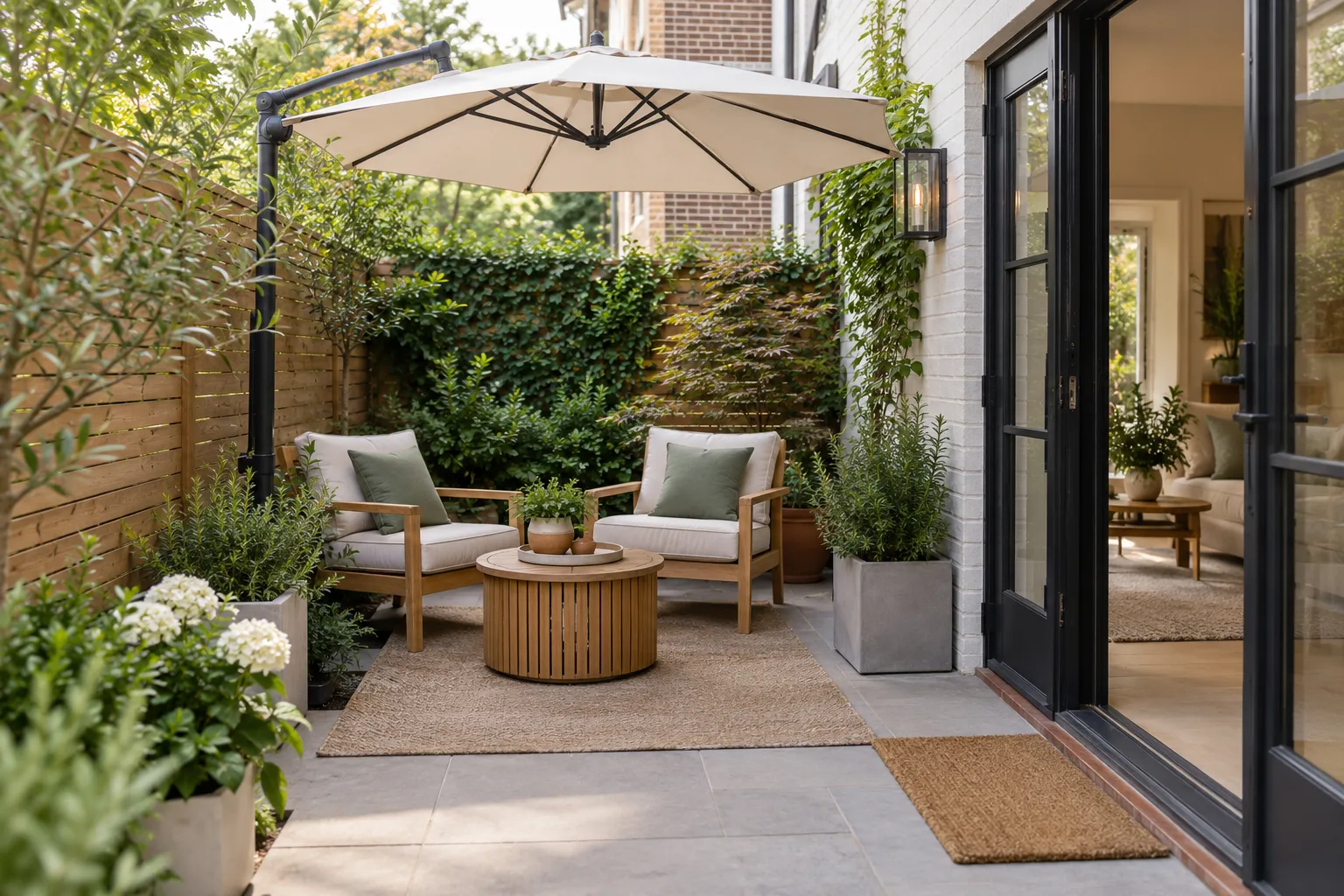
A patio umbrella can make a compact outdoor area more usable, but the canopy is only one part of the footprint. The pole, base, chair movement, door swing, roofline, railing, and storage plan all determine whether an umbrella fits without making the patio harder to use.
Start with the exact shade target. A dining table needs shade centered over seated users, while a reading chair may need adjustable coverage later in the day. Measure the open surface and overhead space, then compare umbrella formats by how they occupy the floor—not by canopy width alone.
What matters most in a small space
- Shade target: the table, lounge chair, or activity area you actually want to cover.
- Canopy shape: round, square, rectangular, or wall-adjacent shapes suit different layouts.
- Pole position: centered, offset, or wall-side placement changes furniture options.
- Base footprint: include the complete base, weights, handles, and any rotating mechanism.
- Overhead clearance: check doors, eaves, branches, lights, screens, and neighboring property.
- Wind guidance: follow the specific umbrella and base instructions for setup, closing, and storage.
- Daily handling: opening, tilting, moving, covering, and storing should be realistic for the user.
- Property restrictions: renters should confirm lease, landlord, building, and association rules before anchoring anything.
Patio umbrella types compared
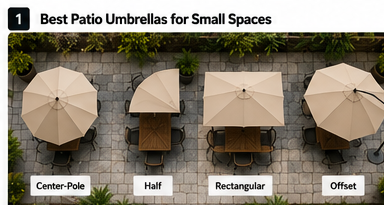
| Umbrella type | Useful for | Small-space advantage | Watch for |
|---|---|---|---|
| Center-pole market umbrella | Bistro and dining tables with umbrella holes | Keeps the support within the table footprint | Base room below the table and chair clearance |
| Half umbrella | A table or bench close to a flat wall | Shallow wall-side profile | Wall compatibility, canopy movement, and approved stabilization |
| Rectangular umbrella | Narrow tables or linear seating | Shade follows a long, slim zone | Rotation, corners, and overhead conflicts |
| Offset or cantilever umbrella | Seating that cannot accept a center pole | Keeps the pole outside the furniture group | Large base and swept canopy path |
| Tilting umbrella | Changing sun angles | Redirects shade without moving furniture | Tilt mechanism reach and clearance |
| Portable clamp-style shade | Temporary targeted shade where approved | Little or no floor base | Exact mounting compatibility and property permission |
Center-pole umbrellas make sense when the table does the organizing
A center-pole umbrella is usually the simplest choice for a table designed with an umbrella opening. The table helps define the shade zone and prevents the pole from consuming a separate strip of floor. It works best when diners can still pull out chairs and reach the door without stepping around a wide base.
Check the table manufacturer’s compatibility guidance as well as the umbrella and base instructions. A table opening does not replace a suitable base, and a base that technically fits beneath the table may still interfere with feet or chair legs.
Half umbrellas can protect a wall-side zone
A half umbrella places a flat canopy edge near a wall, making it useful for a narrow dining ledge, compact bench, or door-side seating area. It can preserve more open floor than centering a full round canopy over the same furniture.
The wall, canopy, and support still need compatible clearances. Do not improvise wall attachments or assume the building permits anchoring. Confirm how the product is intended to be stabilized and whether the canopy can open and close without striking siding, trim, windows, lights, or the roof edge.
Offset umbrellas trade pole placement for a larger base
A cantilever umbrella can keep a pole out of a conversation area, but the base and support often occupy substantial floor space outside the shaded zone. On a small patio, that trade can be worthwhile only when the base can sit at a low-traffic edge and the canopy can rotate or close without crossing a doorway.
Draw the base as a real rectangle on the plan. Include required weights and the full movement envelope described by the manufacturer. A canopy shown floating over furniture can hide the part most likely to crowd the patio.
This post may contain affiliate links. If you buy through them, Small Space Outdoors may earn a commission at no additional cost to you.
Current patio umbrella examples to compare
These are current examples for three different small-patio layouts, not ranked picks. Small Space Outdoors has not personally tested them. Measure the canopy, pole, complete base, furniture movement, and closing path first; then follow the selected umbrella and base manufacturers’ current setup, wind, closing, and storage instructions.
For a compact center-pole table: AMMSUN 6.5-Foot Patio Umbrella
Amazon currently lists a round canopy measuring 6.5 feet along the curve and about 6 feet across when open, with a steel pole and ribs, push-button tilt, and a push-open/pull-close mechanism. The base is not included. Editorially, this is the most straightforward example for a compatible small table with an umbrella hole, provided the separate base and chair movement fit the measured layout.
View the AMMSUN 6.5-Foot Patio Umbrella on Amazon.
For a wall-adjacent shade zone: COBANA 7.5-by-4-Foot Half Rectangular Umbrella
Amazon lists a 7.5-by-4-foot half-rectangular canopy, five steel ribs, a steel pole, and a crank opening mechanism. The base is not included. Its flat-side format can make sense beside a wall or glass door, but buyers still need space for the specified compatible base and must confirm that the canopy can open and close without contacting the building.
View the COBANA Half Rectangular Patio Umbrella on Amazon.
For a narrow rectangular table: PURPLE LEAF 6-by-4-Foot Rectangular Market Umbrella
Amazon currently lists a 6-by-4-foot rectangular canopy with dual tilt, an aluminum frame with eight ribs, and 200 gsm polyester fabric. The base and furniture are not included, and the listing says to use a table under 46 inches high so the umbrella can fully close. Editorially, the rectangular outline is worth comparing when the shade target is long and narrow rather than round.
View the PURPLE LEAF 6-by-4-Foot Rectangular Market Umbrella on Amazon.
Plan the base before the canopy
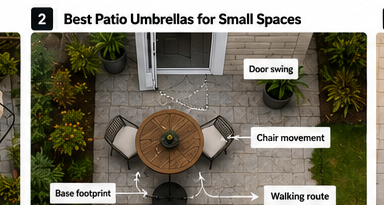
Mark the base footprint with painter’s tape or paper before buying. Put chairs in their in-use positions, open the door fully, and walk the normal route while carrying a tray or watering can. This simple test reveals conflicts that product photos rarely show.
Comfortable circulation is a planning goal, not a universal code distance. Actual requirements vary by property, local rules, door and exit conditions, and lease or association restrictions. Keep required routes unobstructed and verify any rules that apply to the site.
Match canopy shape to the furniture zone
Round and square canopies tend to suit centered bistro groups. Rectangular canopies often follow narrow tables, benches, or side-by-side chairs more efficiently. Instead of choosing the largest canopy that fits the patio, choose the smallest shape that covers the priority seats during the hours the space is used.
If furniture is still being selected, use the footprint method in Best Patio Furniture for Small Spaces. For a square layout, the door-first plans in How to Arrange Furniture on a 10×10 Patio help identify where a base can stay out of the main route.
Wind, closing, and storage are part of the decision
No umbrella should be treated as permanently safe in wind. Wind exposure changes with building height, corners, gaps, nearby walls, and storms. Follow the manufacturer’s instructions for the umbrella, base, anchoring, closing, and weather limits; close or store the umbrella when directed.
Before buying, decide where a closed canopy will rest and where the umbrella will go out of season. Measure storage length, door width, stair turns, and any elevator. A model that is easy to close but impossible to store may remain exposed longer than intended.
Maintenance questions to check
- Can the canopy fabric be removed or cleaned as directed?
- Can the operating mechanism be reached without climbing over furniture?
- Will runoff land on seating, doors, or neighboring property?
- Can the base be moved for cleaning without unsafe lifting?
- Are replacement canopy or hardware details available from the manufacturer?
- Does the closed umbrella stay clear of grills, heaters, lights, and exits?
A practical buying sequence
- Measure the floor, overhead area, door swing, and shade target.
- Choose the pole position that creates the fewest conflicts.
- Compare complete base footprints, including required weights.
- Check canopy shape against the actual furniture arrangement.
- Review manufacturer wind, installation, operating, and storage instructions.
- Confirm property permission before anchoring or attaching anything.
- Tape the footprint on the patio and test the route before ordering.
The takeaway
For many small patios, a center-pole umbrella through a compatible bistro table is the cleanest arrangement. A half umbrella can serve a wall-side zone, while an offset model helps only when its larger base has a low-traffic home. Treat the base, movement path, wind plan, and storage route as seriously as the canopy.