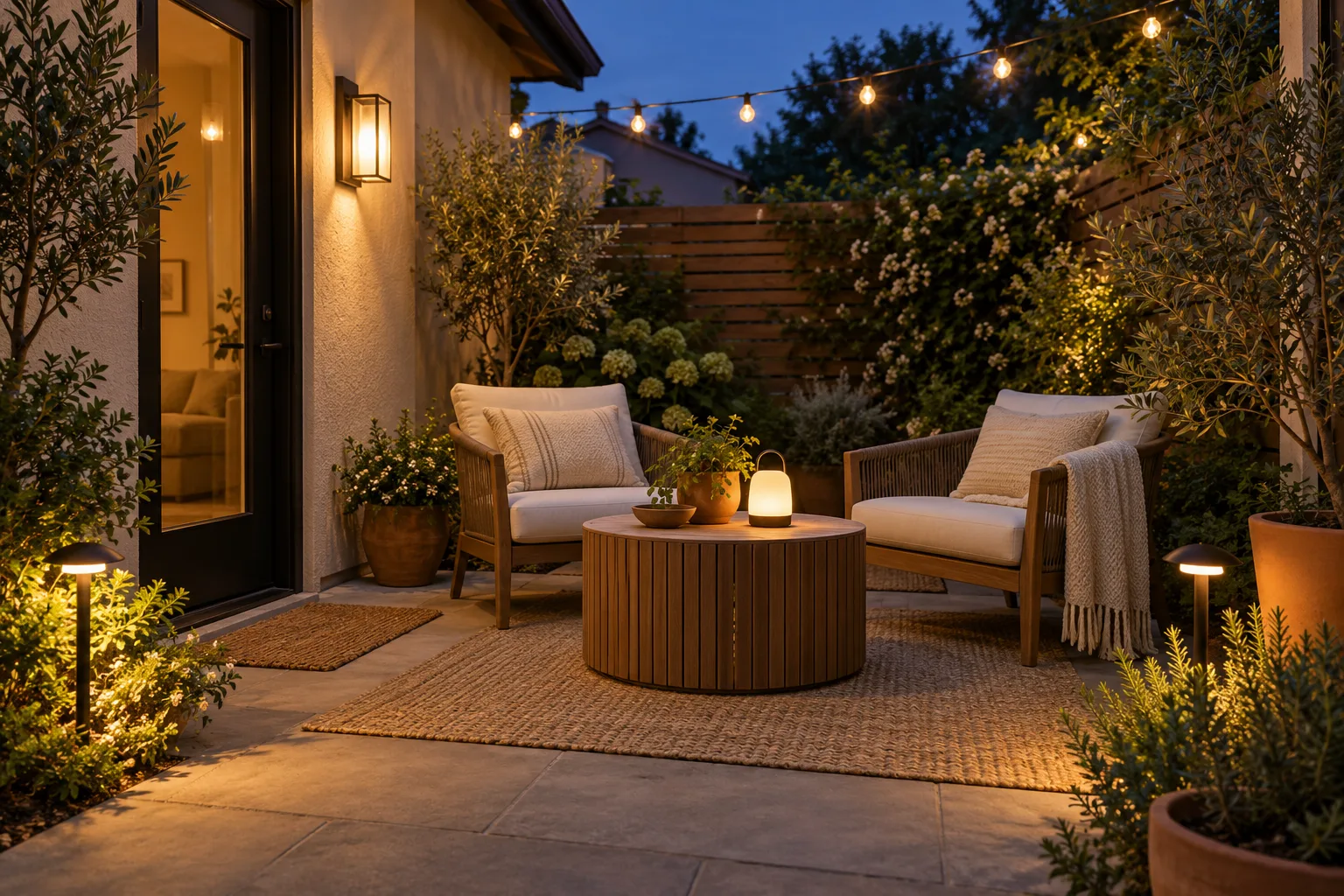
The best lighting for a small patio is usually a small group of lights with separate jobs. One fixture helps at the door, another supports dining or reading, and a low ambient source softens the background. Trying to make a single bright light do everything often creates glare and hard shadows.
Begin with how the patio is used after dark. Mark the lock, steps, table, grill or work surface, seating, and route. Then choose the least complicated combination that makes those areas visible without shining into windows or neighboring property.
Decision factors for compact patio lighting
- Lighting job: entry, step, task, path, or ambient light.
- Placement: wall, ceiling, table, floor, planter, or approved overhead support.
- Power: hardwired, plug-in, rechargeable, battery, or solar.
- Mounting: use compatible hardware and obtain property permission where required.
- Weather exposure: verify the exact fixture, cord, connection, and power supply suit the location.
- Glare: shield bright sources from seated eyes, windows, and neighbors.
- Controls: switching, timers, sensors, charging, and seasonal changes should be practical.
- Maintenance: plan cleaning, battery replacement, bulb access, and storage.
Outdoor lighting types compared
| Lighting type | Best role | Small-space advantage | Main constraint |
|---|---|---|---|
| Wall sconce | Entry and door hardware | Uses no floor space | Electrical work, mounting, and glare |
| Portable table lamp | Dining or reading task | Movable and targeted | Charging, stability, and weather exposure |
| Low path or step light | Changes in level and route edges | Keeps light near the walking surface | Placement, trip risk, and mounting |
| String lights | Soft ambient layer | Spreads small points overhead | Support, sag, power, wind, and property permission |
| Solar accent light | Supplemental marker light | No cord route | Sun exposure, seasonal performance, and battery care |
| Under-rail or ledge light | Low indirect glow where approved | Can hide the source | Exact surface compatibility and installation |
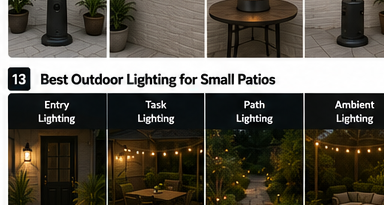
Start with the door and level changes
The lock, threshold, steps, and transitions deserve attention before decorative lighting. An existing wall fixture may already serve this role if it is clean, functional, and appropriately aimed. Replacement or new hardwired work should follow the fixture instructions and applicable electrical requirements.
Keep switches, sensors, house numbers, and security devices visible. Avoid placing a portable light where opening the door or carrying packages can knock it over.
Use portable light for a focused task
A rechargeable outdoor table lamp can bring light close to a meal, book, or game without permanent installation. Check the current outdoor-use, charging, battery, cleaning, and storage instructions. A stable low center of gravity is useful on a compact table.
Do not let a lamp consume the surface needed for plates or drinks. A nearby stool or approved wall shelf may serve better if it remains out of the route.
String lights need real supports
String lights can create an even ambient layer, but the attachment points, sag, cord, plug, and weather exposure must all be suitable. Do not attach to a railing, gutter, tree, facade, or neighboring structure unless the system and property permission support that use.
Use only lighting, connectors, and power arrangements listed for the intended outdoor location. Follow current instructions for maximum connected runs, support spacing, weather protection, and seasonal removal rather than improvising.
Solar lights work best as a supplement
Small solar markers can identify a planter edge or path boundary without a cord, but performance depends on actual sun, season, panel position, battery condition, and weather. Treat them as a supplemental layer unless the exact product and site provide reliable task lighting.
This post may contain affiliate links. If you buy through them, Small Space Outdoors may earn a commission at no additional cost to you.
Current outdoor lighting examples to compare
These are current examples for three different power and placement needs, not ranked picks. Small Space Outdoors has not personally tested them. Confirm the manufacturer’s current outdoor-use, mounting, charging, cord, weather-exposure, and installation instructions, and follow applicable property and local electrical requirements.
For overhead ambient light with an outlet: Brightech Ambience Pro 24-Foot String Lights
Amazon lists a 24-foot plug-in, 110-volt string with seven 2-watt LED bulbs spaced 3 feet apart. The bulbs are dimmable, but the dimmer is sold separately, and the listing designates the string for indoor or outdoor use. This is an ambient-light option only where an approved outlet, supported hanging route, cord path, and manufacturer-compliant mounting plan are available.
View the Brightech Ambience Pro 24-Foot String Lights on Amazon.
For low-profile solar markers: SOLPEX Small Solar Ground Lights, 10-Pack
Amazon currently lists each stainless-steel-and-plastic light at approximately 2.4 inches high by 2.7 inches in diameter, powered by its own solar cell with automatic dusk-to-dawn operation. The listing identifies an IP44 rating, stake installation in soil, and no wiring requirement, while advising against locations that flood easily. Editorially, these are better treated as accent or marker lights than as the only illumination for steps or required routes.
View the SOLPEX Small Solar Ground Lights on Amazon.
For movable table light without a live cord: Tubicen Rechargeable Outdoor Lantern
Amazon lists this rechargeable lamp at 4.5 inches wide by 8.7 inches high with a 4000 mAh battery, USB charging, four touch-controlled brightness levels, and an IP44 splash-protection claim. Its handle and cordless operation make it relevant for a small table that changes position, but it still needs dry charging and storage according to the current manufacturer instructions.
View the Tubicen Rechargeable Outdoor Lantern on Amazon.
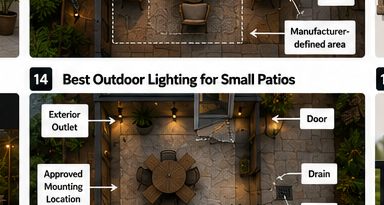
Map power, mounting, and the walking route
Draw every outlet, door, drain, step, seat, table, and likely mounting point. Keep cords and portable lights out of the main route and required exits. Do not run power under rugs or through doors unless the complete arrangement is explicitly permitted by current product instructions and electrical requirements.
Building, landlord, association, and local rules vary. Renters should favor rechargeable or freestanding lights when permanent mounting or new electrical work is not approved.
Control glare with position, not just lower output
Place bright sources above, behind, or beside the user rather than directly at eye level across a tiny seating zone. Shields, shades, and reflected light can make a lower level more comfortable. Check the result from indoors and from neighboring sightlines.
Coordinate lighting with the patio layout
A lighting layer should reinforce the activity zone established by furniture. Review Small Patio Makeover Ideas That Don’t Feel Crowded before adding fixtures to every edge. For a square patio, use How to Arrange Furniture on a 10×10 Patio to identify the open route and focal point.
Practical lighting checklist
- Mark the entry, steps, tasks, and route.
- Assign one lighting job to each proposed fixture.
- Verify outdoor-location suitability and power requirements.
- Confirm mounting permission and compatible supports.
- Keep cords, fixtures, and controls out of the route.
- Check glare from every seat, window, and neighboring view.
- Plan charging, switching, cleaning, and seasonal storage.
The takeaway
A strong small-patio plan often combines a functional entry light with one portable task light and one restrained ambient layer. Keep power and mounting simple, shield glare, and let darkness remain between focal areas. More fixtures do not automatically create better light.