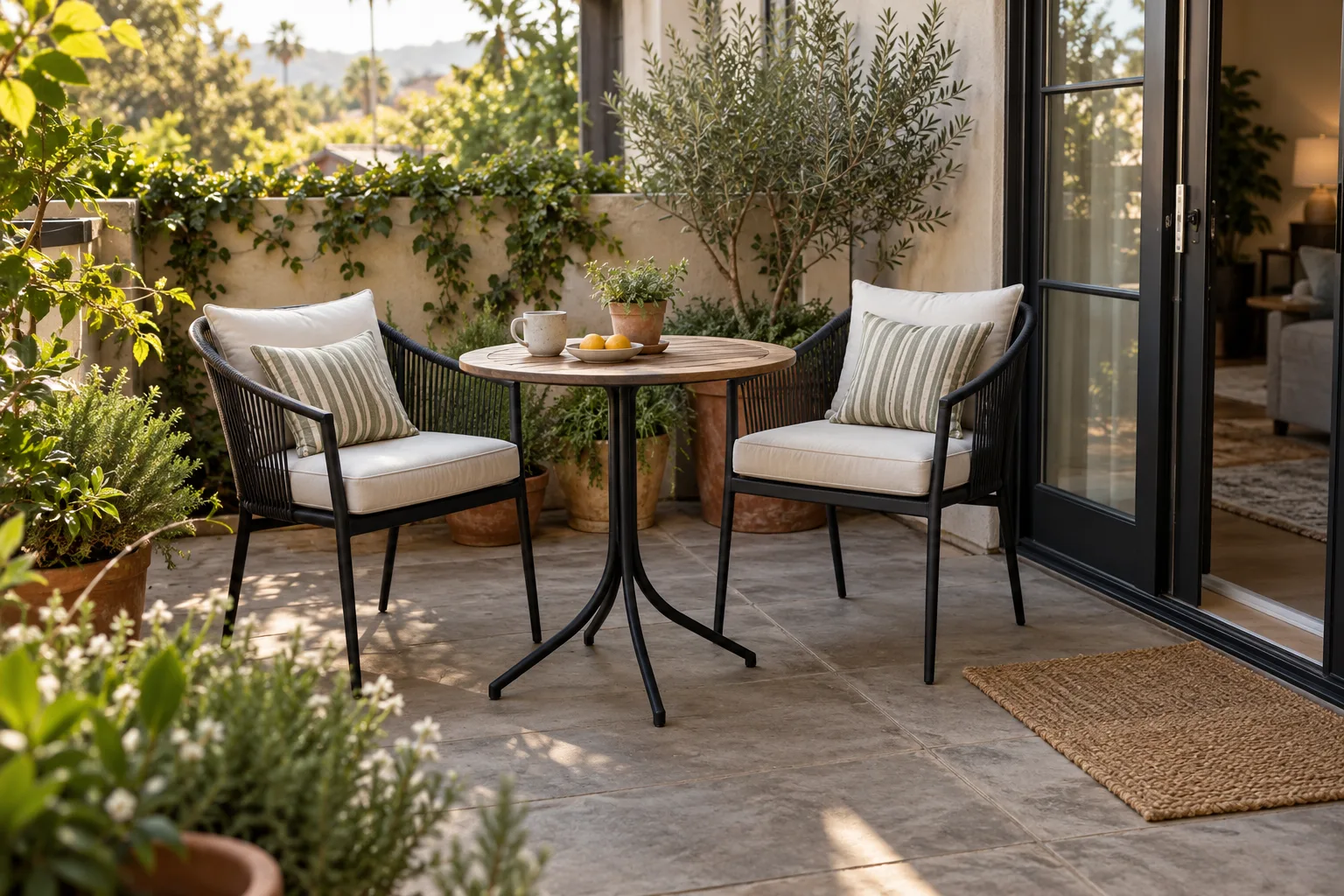
A three-piece patio set can be a sensible fit for a compact outdoor space because it gives two people a coordinated place to sit with one shared surface. But the label “three-piece” says nothing about the set’s footprint. Two deep lounge chairs and a wide table can need far more room than a folding bistro set.
The best configuration is the one that fits your primary activity and still allows the door, chairs, and walking path to work. Compare total dimensions and required clearances before comparing colors or cushion styles.
The best three-piece set types by use
| Set type | Best for | Why it saves space | Main tradeoff |
|---|---|---|---|
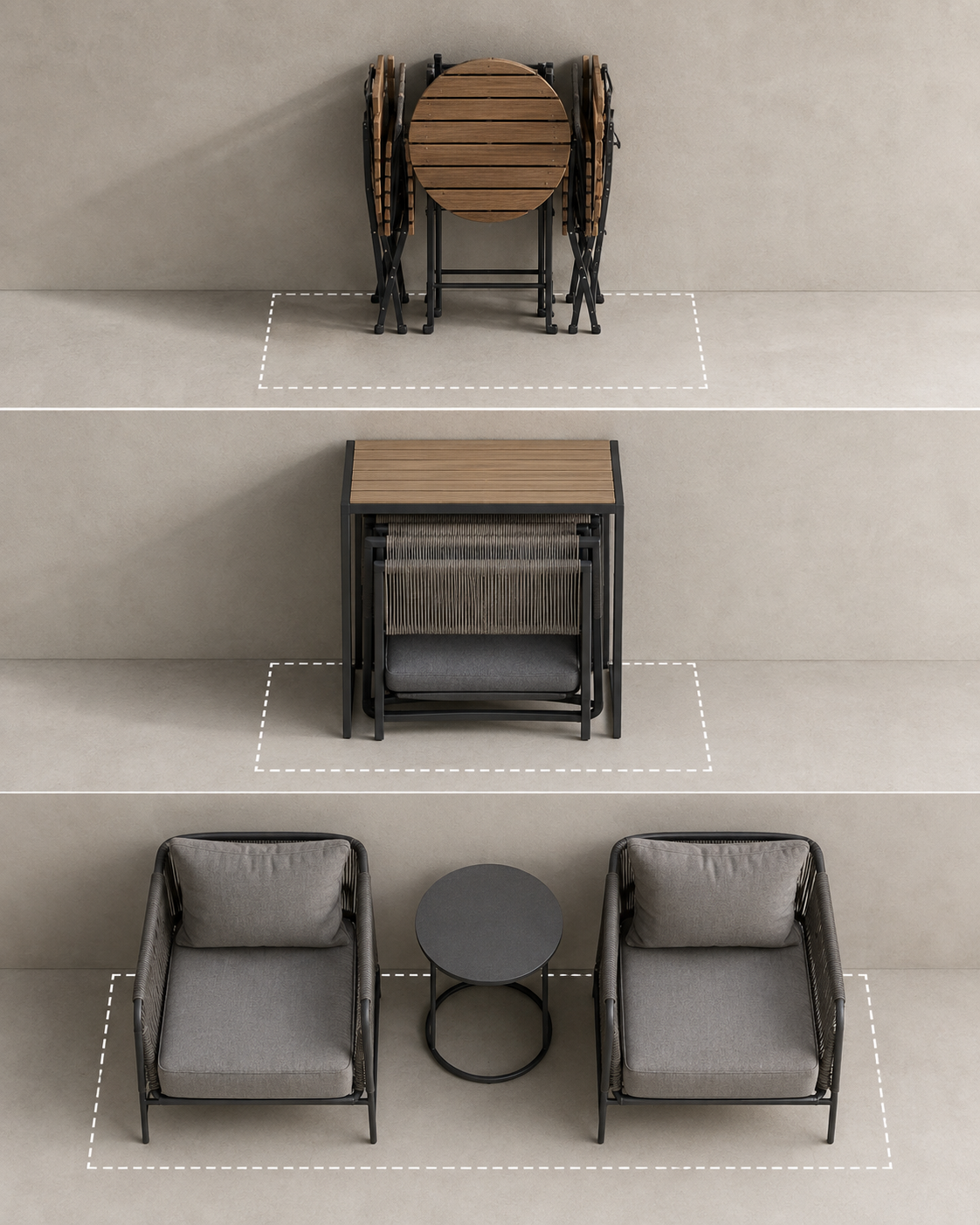
| Folding bistro set | Flexible patios and balconies | Pieces can be folded and moved | Folded pieces still need storage |
| Compact café set | Coffee and light meals | Small table and upright chairs | Allow room to pull chairs out |
| Nesting chair set | Occasional use | Chairs tuck partly below the table | Check knee room and ease of access |
| Two lounge chairs plus side table | Reading and conversation | No large central coffee table | Deep seats can dominate the floor |
| Two stools plus high table | Very narrow footprints | Small top and compact seats | Not ideal for every user |
| Two ottomans plus low table | Casual, flexible seating | Ottomans may tuck under the table | Limited back support |
This guide compares configurations rather than naming a single universal winner. Product dimensions and construction vary widely within every category, so the fit must be evaluated set by set.
This post may contain affiliate links. If you buy through them, Small Space Outdoors may earn a commission at no additional cost to you.
Three current sets to compare
These are non-ranked examples for three different use cases. Each listing was available when checked, but product details and availability can change. Small Space Outdoors has not personally tested these sets. Measure the occupied layout and verify the current Amazon listing before ordering.
For flexible storage: Grand patio 3-Piece Folding Patio Bistro Set
Amazon’s listing identifies a round table and two chairs that fold. This configuration suits a patio or balcony that needs to shift between seating and open floor space. Confirm the folded footprint and decide where all three pieces will be stored.
View the Grand patio folding bistro set on Amazon.
For a compact conversation zone: Best Choice Products 3-Piece Outdoor Wicker Conversation Bistro Set
The listing pairs two separate chairs with a shared side table that includes a storage compartment. It matches the lounge-style format when you want individual seats and a central surface without adding a sofa. Verify the complete chair depth and leave enough room to sit down and stand up.
View the Best Choice Products conversation bistro set on Amazon.
For lounge seating with a smaller stored footprint: Tangkula Outdoor Bistro Set with stackable adjustable-back chairs
Amazon’s listing includes two chairs with adjustable, folding backs that can be stacked, plus a shared coffee table. This option is relevant when relaxation and stored footprint both matter. The chairs need more floor space in reclined positions, so measure the layout at the angle you expect to use.
View the Tangkula stackable lounge set on Amazon.
Measure for the set in use
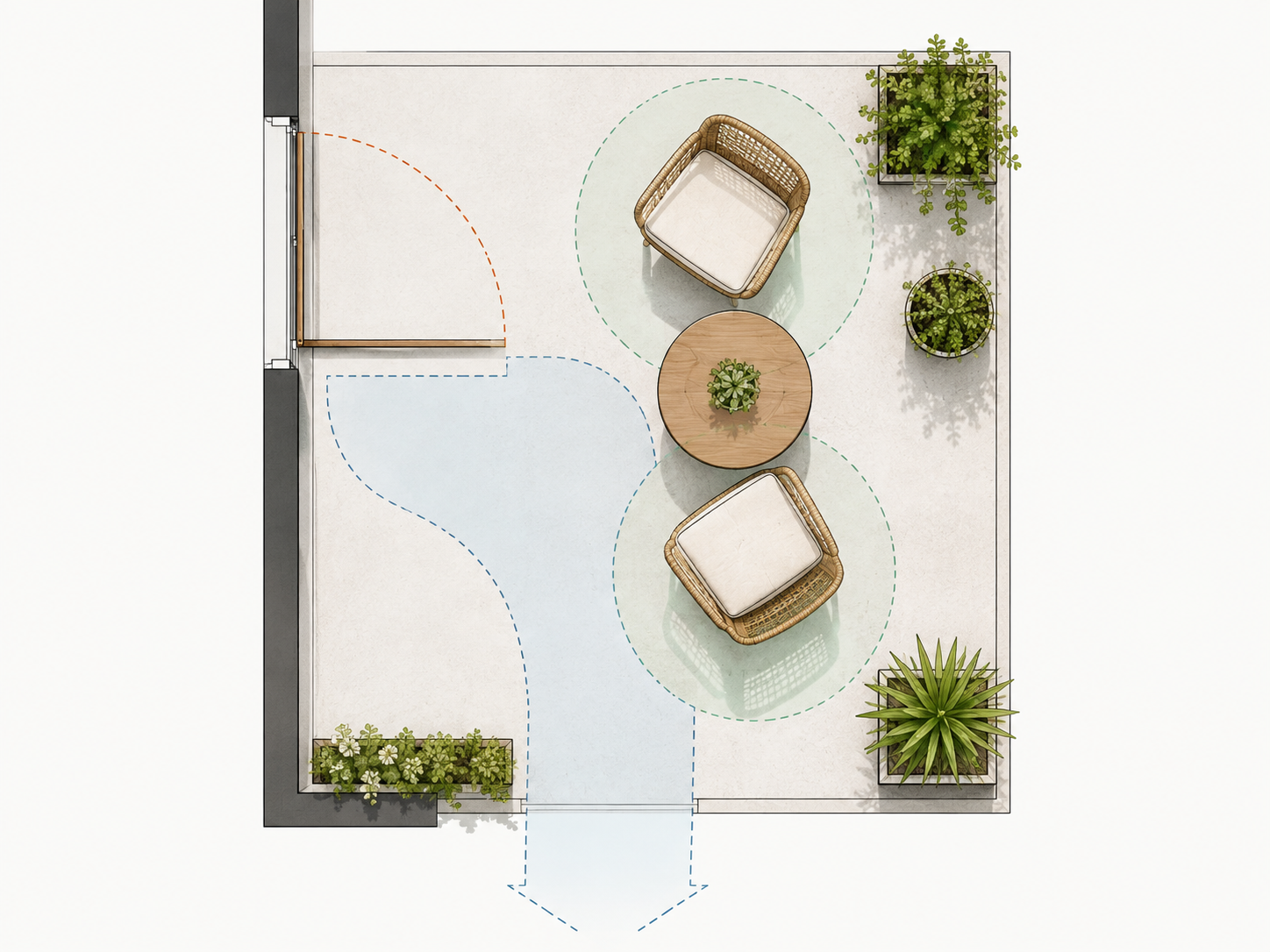
Do not measure only the table and chair frames. A dining chair needs room behind it when someone sits down or stands up. A reclining lounge chair needs space at its deepest position. Folding furniture needs enough clearance for hinges and moving parts.
- Measure the patio’s usable width and depth.
- Mark door swings, sliding-door access, gates, stairs, and required egress.
- Find the full width and depth of each product—not only the tabletop or seat.
- Add the space needed to pull out, approach, or recline each chair.
- Outline the arrangement with painter’s tape and use it for a normal day.
For comfortable movement, a main route of roughly 30 to 36 inches can be a useful general planning target when the space permits. This is not a universal code or property requirement; actual requirements can vary by property, local rules, and lease or association restrictions. Required egress, door operation, and applicable safety instructions take priority. On a very small balcony, the correct decision may be fewer or smaller pieces rather than a tighter walkway.
Best for flexibility: folding bistro sets
A folding set is useful when the same patio must support seating, gardening, exercise, or a clear route at different times. The table can move against a wall, one chair can be removed, or the full set can be stored during the off-season.
Check how securely each piece locks in the open position, whether fingers are protected during folding, and whether the set stands steadily on your surface. Also decide where folded pieces will go. A folding feature does not save space if the furniture stays open all year because there is nowhere suitable to store it.
Best for meals: compact café sets
A café set normally pairs two upright chairs with a dining-height table. It is the most practical three-piece format for eating, writing, or working outside because the surface is closer to a conventional table height than a low side table.
Round tops ease circulation around corners, while square tops can align neatly with a wall. A pedestal base may offer flexible leg placement, but confirm stability and follow wind guidance for exposed locations. Chairs that slide substantially under the top reduce the footprint when no one is seated.
Best for a tidy footprint: nesting configurations
Some three-piece sets are designed so the chairs or stools fit partly beneath the table. This can create a clean stored shape and protect more open floor between uses. Study the set in both positions: tucked away and occupied.
A product photo may show the chairs nested tightly, but that does not reveal the room needed to pull them out or sit comfortably. Check the opening width, legroom, handles, and whether cushions must be removed before nesting.
Best for relaxing: two lounge chairs and a side table
This arrangement works when comfort matters more than dining. A small shared table placed between the chairs keeps the center open and provides a surface for drinks or books. Angling the chairs slightly toward each other can support conversation without requiring a full outdoor sofa.
Total chair depth is the critical measurement. Thick backs, curved frames, reclining mechanisms, and deep cushions can enlarge the footprint. Compare the complete assembled dimensions and tape them on the floor before buying.
For more ways to compare scale and furniture functions, read Best Patio Furniture for Small Spaces.
When stools or ottomans make sense
Backless seating is visually light and can tuck beneath a table, making it useful for occasional meals or entertaining. It is less supportive for long sessions and may be difficult for some people to use. A tall table with stools also changes the view and balance requirements, which matters on exposed balconies.
Choose this format only if it suits the people who will use it most. Space efficiency is not helpful when the seating is uncomfortable or inaccessible.
Frames, cushions, and maintenance
Compact proportions do not eliminate outdoor-care questions. Review manufacturer guidance for exposure, cleaning, assembly, weight limits, anchoring, and storage. Powder-coated metal can create a slim silhouette, wood can add warmth, woven synthetic frames can feel relaxed, and molded resin can be easy to move. Performance depends on the specific construction and environment.
Cushions add comfort but also require a drying and storage plan. Removable covers can simplify some cleaning tasks, yet care instructions differ. If storage is limited, a comfortable sling, woven seat, or contoured solid seat may be more practical than loose cushions.
Balcony-specific checks
- Follow the building’s rules for furniture, floor coverings, and railing clearance.
- Do not block drainage, doors, fire access, or required egress.
- Consider wind exposure and follow manufacturer instructions for securing or storing lightweight pieces.
- Keep climbable furniture away from railings when children may use the space.
- Confirm that the set’s weight and use are appropriate for the location; ask the property owner or a qualified professional when necessary.
A final comparison checklist
- Use: dining, conversation, lounging, or flexible use?
- Occupied footprint: how much room does the set need while people are seated?
- Stored footprint: do chairs fold, stack, or nest as expected?
- Traffic: can the main route and door remain clear?
- Comfort: do seat height, depth, arms, and back support suit the users?
- Exposure: are materials and care requirements appropriate for the location?
- Delivery: will packages and assembled pieces fit through the route?
- Storage: where will cushions and lightweight components go during bad weather?
If your patio is close to 100 square feet, test these choices against the layouts in How to Arrange Furniture on a 10×10 Patio.
The takeaway
For most small spaces, the strongest three-piece set is either an upright bistro arrangement for meals or two reasonably shallow chairs with a compact shared table for relaxing. Folding and nesting features can add flexibility, but only when the pieces remain stable, comfortable, and easy to store. Measure the occupied layout—not the catalog silhouette—before deciding.