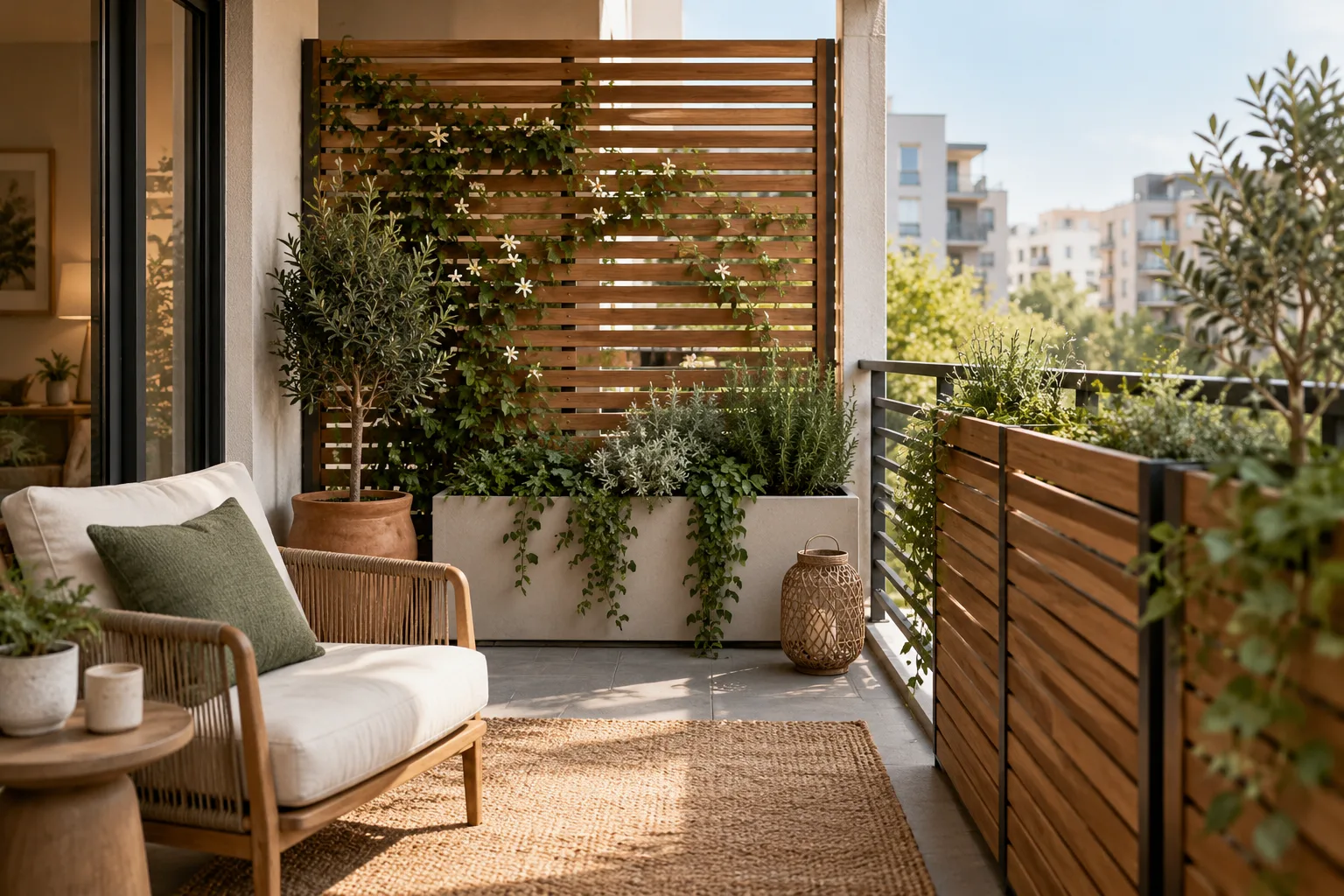
The best privacy screen for a balcony or small patio blocks the specific sightline that bothers you without creating a new problem with wind, light, movement, drainage, or property rules. Start by locating the view you want to interrupt, then choose the least intrusive screen that solves it.
Freestanding panels, planter-backed screens, approved fabric panels, slatted dividers, and plant-supported structures each have different footprints and mounting needs. No single format is best for every property, and a screen that works at ground level may be unsuitable on an exposed balcony.
Decision factors that matter first
- Target sightline: side neighbor, street, parking area, or lower-level walkway?
- Location: ground-level patio, covered balcony, or exposed upper floor?
- Available footprint: how much floor can a base or planter occupy?
- Mounting permission: can anything attach to the building or railing?
- Wind and airflow: will the screen act like a sail or trap heat?
- Required access: does it affect the door, exit route, drain, or utility area?
- Maintenance: will fabric, wood, plants, or hardware be easy to clean and inspect?
Rules vary by building, landlord, association, lease, and local requirements. Never assume a railing, wall, ceiling, or floor can accept attachments. Confirm permissions and applicable fire, height, appearance, and egress rules before buying or installing a screen.
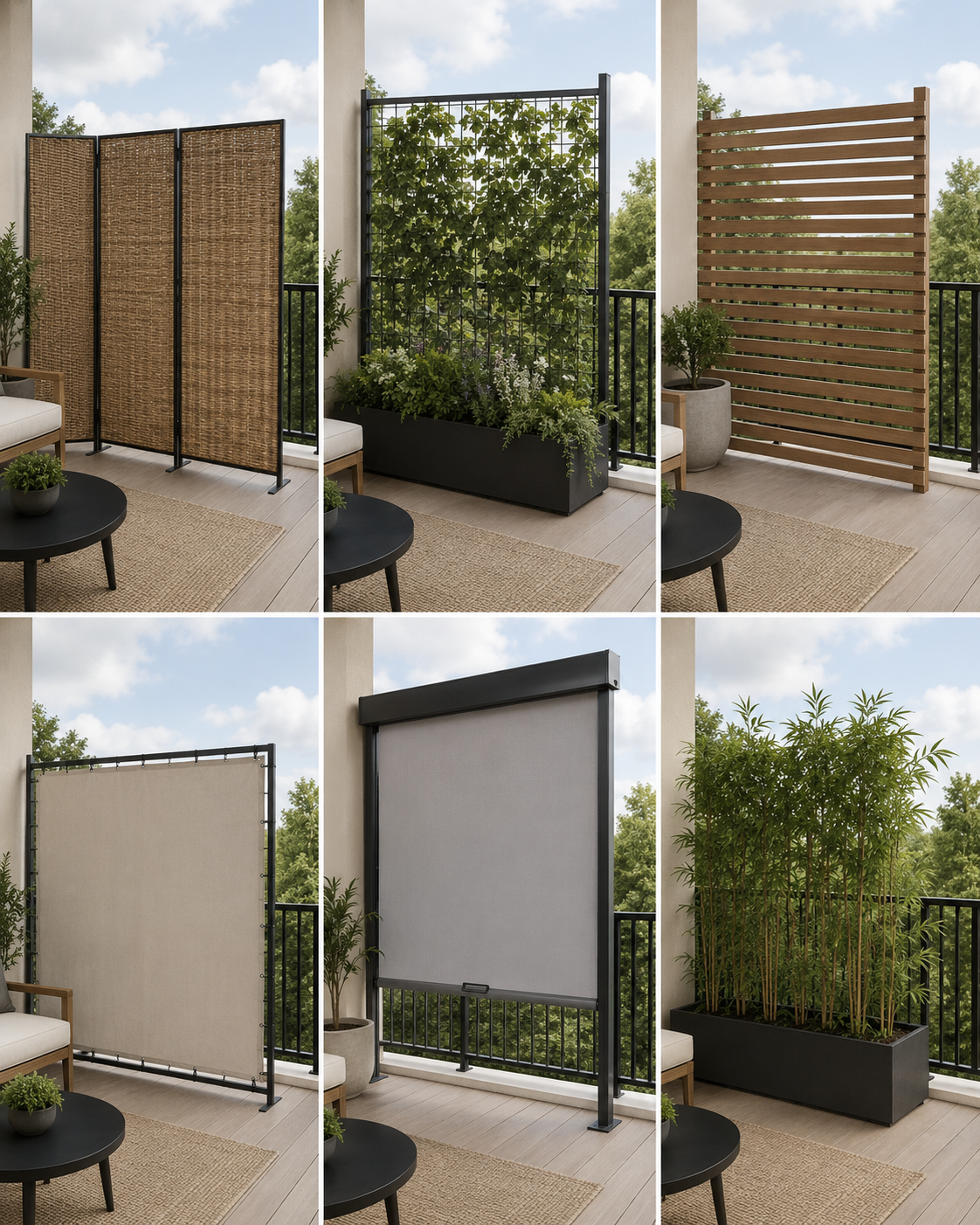
Privacy screen types compared
| Screen type | Best suited for | Space tradeoff | Key check |
|---|---|---|---|
| Freestanding panel | Renters needing a reversible option | Base uses floor area | Stability and wind guidance |
| Planter-backed screen | Privacy plus planting | Usually deeper and heavier | Placement, drainage, and intended load |
| Slatted divider | Partial screening with airflow | Frame and feet need clearance | Approved mounting or stable base |
| Outdoor fabric panel | Lightweight visual screening | Minimal visual bulk | Permitted attachment and wind exposure |
| Retractable screen | Privacy only when needed | Compact when closed | Installation surface and operating clearance |
| Plant-based screen | Softer, changing privacy | Planters need floor and care access | Sun, water, growth, and stability |
Best for renters: freestanding panels
A freestanding screen avoids drilling when the design is genuinely stable without attachment. It can move with the furniture layout and may be stored when privacy is not needed. The tradeoff is the base: wide feet or weighted planters can consume valuable floor and create obstacles.
Use only as directed by the manufacturer and within property rules. Do not add improvised weights, tie a panel to a railing, or rely on furniture to hold it upright. Wind exposure may make a freestanding product inappropriate for some locations.
Best for combining functions: planter-backed screens
A screen integrated with a planter can create privacy and a planted focal point in one zone. This format suits a patio where the planter replaces several scattered pots. On a balcony, the combined size, weight, drainage, and wind profile require careful property and product review.
Confirm the product’s intended use and planting capacity. Wet soil and mature plants change the total load and balance. Keep drainage away from walking surfaces and neighboring property, and leave access for watering and cleaning.
Best for airflow: slatted dividers
Slats interrupt a direct view while allowing more light and air than a solid panel. The angle, spacing, and viewer position determine how much privacy they provide. A slatted screen may work especially well along one side rather than across the entire balcony or patio.
Freestanding slatted units still need stable bases, and attached units require an approved structure and installation method. Wood and metal finishes have different maintenance needs, so use the manufacturer’s exposure and care guidance.
Fabric privacy panels: light but location-dependent
Outdoor fabric can soften a railing or open side with little physical depth. It must be specifically suitable for the intended outdoor use and attached only with an approved system. Solid fabric catches wind and may affect airflow more than an open-weave material.
Do not wrap or cover a railing in a way that interferes with its function, drainage, inspection, or building requirements. Confirm cleaning, removal, flame-related guidance, and seasonal storage instructions.
Retractable screens: privacy on demand
A retractable screen preserves openness when closed and provides a larger privacy surface when extended. It can be useful between adjacent patios where a suitable installation surface exists. The mechanism, housing, anchors, and tension system make this a mounting-dependent choice.
Measure the operating path and confirm that furniture, doors, and planters will not interfere. Use only within the product’s wind guidance and retract it when directed.
Plant-based privacy: softer but slower
Plants can interrupt sightlines while adding texture, but they are not instant architecture. Choose plants for actual light, wind, temperature, and watering conditions. Consider mature size, seasonal leaf loss, pruning, and the time required to reach useful coverage.
A vertical planter may concentrate greenery more efficiently than separate pots. Compare stable formats in Best Vertical Planters for Balconies and Small Patios.
Measure the sightline, not the whole boundary
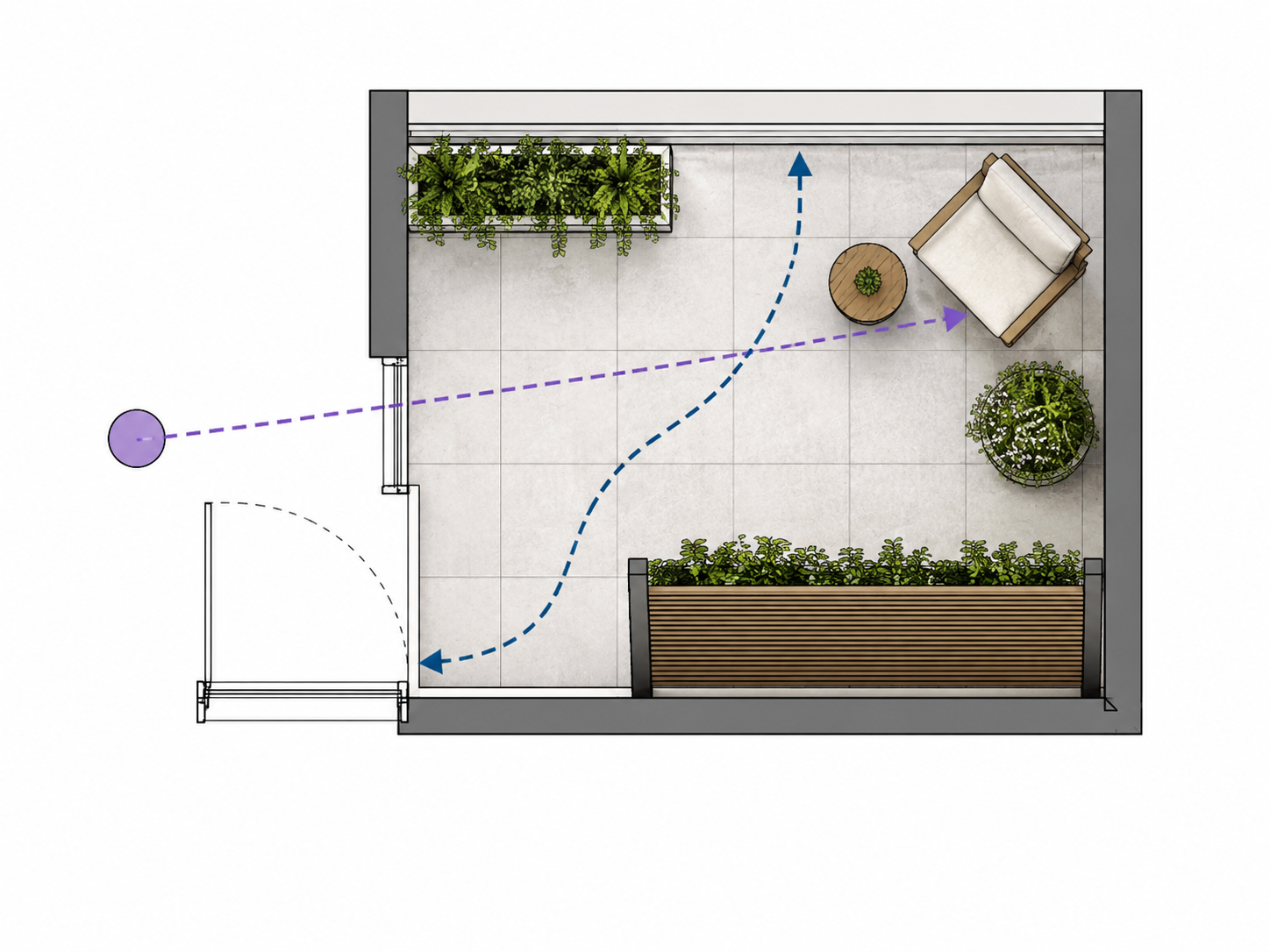
Sit in the primary chair and note where the unwanted view begins and ends. A narrow screen placed close to the viewer may block the same sightline as a much wider screen at the perimeter. Test the idea with a piece of cardboard held safely by another person—never leave a temporary panel unsecured.
Mark the screen’s base on the floor, open the door, walk the route, and move the chairs. Keep drains, railings, utility access, and required exits clear. Partial privacy is often the better small-space solution because it preserves more light and movement.
Privacy without crowding the layout
Treat the screen as part of the furniture plan. A panel behind a compact chair can create a complete retreat; a planter-backed screen may replace other pots. Avoid adding privacy after the balcony is already full.
Use the layout and rule checks in Best Balcony Furniture for Small Spaces, then refine the overall look with Apartment Balcony Makeover Ideas That Still Leave Room to Move. Ground-level readers can also adapt the editing principles in Small Patio Makeover Ideas That Don’t Feel Crowded.
A privacy-screen checklist
- Identify the exact sightline and seated or standing viewpoint.
- Confirm property, lease, association, and local restrictions.
- Choose freestanding or approved mounting based on the location.
- Tape the base footprint and test the door and route.
- Review wind, exposure, maintenance, installation, and storage guidance.
- Protect drainage, railing function, required exits, and utility access.
- Use only enough height and width to solve the privacy problem.
The takeaway
For a compact outdoor space, the strongest privacy screen is usually targeted rather than wall-to-wall. Choose the format by mounting permission, wind exposure, base footprint, and maintenance. Preserve the door, route, airflow, and railing function, and verify every property rule before installation.