
A patio heater can have a narrow base and still require more space than a compact patio can provide. The full decision includes the operating area, heat direction, overhead conditions, fuel or electrical supply, weather exposure, storage, and the specific manufacturer’s instructions.
Begin by confirming that the heater type is allowed and suitable for the exact outdoor location. Do not use an outdoor combustion heater indoors or in an enclosed space. Follow the product manual and applicable fire, electrical, building, lease, landlord, and association requirements.
What matters most before choosing a heater
- Approved location: open-air, covered, wall-adjacent, or other settings only as the product permits.
- Heat direction: radiant direction should match the occupied seating zone.
- Complete footprint: include base, guards, controls, cord, hose, cylinder, or mounting hardware.
- Manufacturer clearances: use the exact product instructions rather than a general rule.
- Fuel or power: confirm compatible supply, connections, circuit needs, and professional installation where required.
- Weather exposure: follow instructions for wind, rain, storage, covers, and operation.
- Movement and stability: consider tipping, wheels, carrying, mounting, and shutdown.
- Property rules: restrictions vary by local authority, building, HOA, landlord, and lease.
Patio heater formats compared
| Format | Potential small-space advantage | Main planning issue | Best question to ask |
|---|---|---|---|
| Freestanding electric radiant heater | No on-site combustion and flexible placement where approved | Base, cord, outlet, weather rating, and tip-over guidance | Can the power route stay clear and compliant? |
| Wall- or ceiling-mounted electric heater | Preserves floor space | Approved mounting, overhead conditions, wiring, and fixed heat direction | Is the structure suitable and installation permitted? |
| Tabletop electric heater | Targets a compact seating area | Table compatibility, cord route, stability, and exposure | Does the table support the exact model as directed? |
| Freestanding fuel-burning heater | Portable heat where permitted | Combustion, ventilation, cylinder, base, wind, and operating area | Does the full appliance system fit the open-air site? |
| Compact directional heater | Focuses heat toward one zone | Clearances and user proximity remain product-specific | Can it serve the seats without entering the route? |
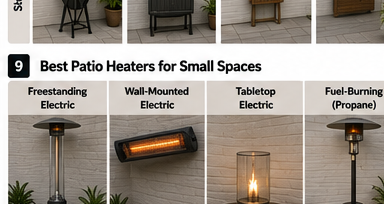
Electric heaters can simplify fuel handling
An electric radiant heater may suit a small zone when the product is approved for the location and a suitable power supply is available. It avoids storing a fuel cylinder, but the cord, plug, outlet, circuit, weather exposure, and mounting requirements become central.
Do not route cords through a doorway, under a rug, or across a walking path unless the manufacturer and applicable electrical requirements explicitly permit the arrangement. Extension-cord use and outlet protection must follow the current instructions and local electrical rules.
Mounted heaters preserve floor but require a suitable structure
A wall- or ceiling-mounted unit can keep the floor open and aim heat at a defined seating area. Installation is not a renter-friendly shortcut: the wall or overhead structure, electrical supply, mounting hardware, weather exposure, and clearances must all suit the specific product.
Obtain property permission and qualified installation where required. Never attach a heater to a railing, temporary screen, or improvised support.
Tabletop heaters need a complete table check
A tabletop heater may look compact, but the supporting table must be compatible with its weight, base, operating instructions, heat exposure, and power or fuel arrangement. It also removes usable tabletop space and may place controls or hot surfaces closer to hands.
Use only on the surfaces and in the locations allowed by the manufacturer. Do not combine it with an umbrella, table covering, or enclosure unless the exact instructions explicitly allow that setup.
Fuel-burning heaters require open-air suitability
A freestanding fuel-burning heater is not appropriate simply because it fits between chairs. Combustion, ventilation, cylinder access, ignition, wind, overhead conditions, shutdown, and storage all shape suitability. Never use it indoors or in an enclosed porch, garage, shed, tent, or similar space.
Check applicable fire rules and property restrictions before purchase. Follow the product and fuel-container instructions for connection, leak checks, operation, moving, and storage.
Map the full operating zone
Draw the patio boundary, doors, windows, roof or awning, screens, railings, furniture, plants, umbrella, rug, utilities, and route. Overlay the exact operating and clearance requirements for the candidate heater. Include the direction heat travels and how users reach the controls and shutoff.
Do not treat a suggested distance as a universal requirement. Clearances and permitted locations vary by product, fuel or power source, property, local rules, and lease or association restrictions.
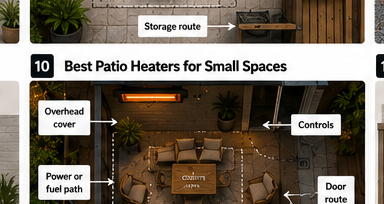
Choose furniture around the heater—not the reverse
A heater should serve a stable seating zone without occupying the door path or inviting chairs to drift into a restricted area. Compact upright chairs are easier to position intentionally than deep lounge pieces in a very small heated zone.
Review furniture footprints in Best Patio Furniture for Small Spaces. If overhead shade is also planned, coordinate the separate base and canopy issues in Best Patio Umbrellas for Small Spaces before assuming both systems fit.
Storage and seasonal use
Plan shutdown, cooling, disconnecting, covering, moving, and storage according to the manufacturer. Measure storage access and keep fuel or electrical components only in approved conditions. A protective cover does not make every heater suitable for permanent exposure.
Decision checklist
- Confirm the heater type is allowed and the location is suitable.
- Read the exact manufacturer installation and operating instructions.
- Map the full operating zone, overhead conditions, exits, and furniture.
- Verify the fuel or electrical supply and installation requirements.
- Plan wind, weather, shutdown, supervision, and storage routines.
- Keep controls and required routes accessible.
- Choose no heater if the patio cannot satisfy the complete requirements.
The takeaway
A directional electric heater may be the most workable format for some compact outdoor spaces when the electrical setup and location are approved. A mounted model can preserve the floor but adds installation requirements. Fuel-burning heaters demand especially careful open-air, property, and fire-rule review. The product manual—not a generic size label—defines whether a heater fits.